The SeaSEC Challenge Weeks are designed to bring together industry, defence, and technology providers to test and demonstrate maritime capabilities in realistic, operational conditions.
This year’s Data2Sea focus was about establishing and maintaining a near-real-time Common Operational Picture (COP) to help protect critical underwater infrastructure.
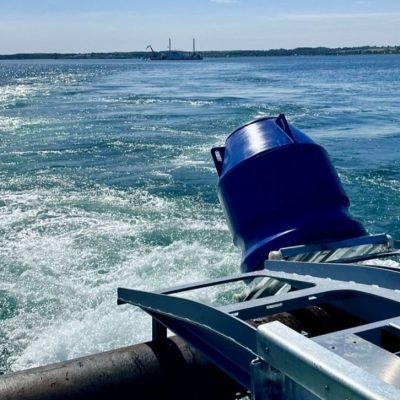
As part of this environment, CUBEDIN partnered with Tuco Marine to support their Sentinel USV during live trials. We were there to solve a practical challenge facing both USV builders and operators: how to integrate multiple onboard systems into a single, coherent architecture – improving visibility, reducing complexity, and enabling future scalability.
The Challenge
Modern USVs are equipped with a growing number of sensors and systems – navigation, surveillance, and mission-specific payloads. However, these systems are often deployed as standalone components.
On the Sentinel USV, key systems including heading, radar, speed, GPS, and depth sounders traditionally operate in isolation. This creates several challenges:
- Increased operational complexity for crews
- Multiple interfaces to manage and maintain
- Limited ability to monitor or support systems remotely
- Barriers to adding new capabilities without increasing system burden
In parallel, there was a requirement to enhance onboard surveillance capability. The vessel’s primary camera was fixed for navigation purposes, meaning it could not be used flexibly for situational awareness during operations.
The CUBEDIN Solution
CUBEDIN partnered with Tuco Marine to deliver a unified integration layer across the Sentinel USV. This enabled:
1. System Integration & Data Unification
We connected core onboard systems – heading, speed, GPS and camera systems into a single, cohesive architecture.
- Data from all systems was normalised and transmitted via MQTT
- Previously siloed systems were brought into one manageable environment
- The solution enabled centralised monitoring, diagnostics, and maintenance
2. Remote Management Capability
By consolidating system data into one platform, CUBEDIN enabled:
- Remote monitoring of vessel systems from any location
- Reduced need for onboard technical intervention
- Ongoing support and updates delivered without physical access
This fundamentally changes how USVs can be supported in operation – moving from reactive, onboard maintenance to proactive, remote management.
3. Interoperability with Operational Systems
The integrated data was fed directly into multiple onshore third-party systems including Systematic’s C4ISR software, SitaWare, enabling:
- Aggregated data visibility
- Improved situational awareness for operators
- Seamless integration into existing command and control environments
4. Flexible Surveillance Capability
To address the limitation of the fixed navigation camera, CUBEDIN rapidly integrated a secondary array of cameras for improved situational awareness around the vessel:
- Fully integrated into the same architecture
- Remotely controllable and reconfigurable during operations
- Provided enhanced situational awareness without interfering with navigation systems
5. Independent Connectivity
The system was connected via a dedicated Starlink terminal:
- Avoiding interference with existing onboard systems
- Ensuring stable, high-bandwidth communication for data and remote access
The Outcome
CUBEDIN’s integration delivered a step-change in how the Sentinel USV’s systems could be operated and monitored.
For USV builders this means:
- Reduced integration complexity and overhead – one architecture instead of many
- Faster capability expansion – add new systems without redesign
- Future-proof platforms – open integration supports evolving requirements
- Improved data visibility – enabling better operator insight and system oversight
For operators this means:
- Reduced complexity – fewer systems to manage
- Increased visibility – all key data in one place
- Lower workload – less manual oversight required
- Remote access – monitor vessels from anywhere
Why It Matters
This project demonstrates a shift from fragmented onboard systems to unified, adaptable architectures.
By enabling open integration, CUBEDIN allows new sensors, radars, sonars, tools, and capabilities to be added over time – without redesigning the platform or increasing complexity for the operator.
The result is a more scalable, maintainable, and operationally effective USV – ready to evolve as mission requirements change.
Summary
At SeaSEC Challenge Weeks Data2Sea 2026, CUBEDIN showed how integration – not just technology – unlocks the full potential of unmanned systems.
By connecting, simplifying, and enabling remote access, we helped transform the Sentinel USV from a collection of systems into a cohesive, manageable, and future-ready platform.